Press Mentions
2
A trust section highlighting media publications, press quotes, or coverage logos.

Press mentions show how an outside publication has discussed a product or company. They can help visitors investigate public coverage, understand a launch, or find an independent account of a topic. The design should make the source and the nature of the coverage clear without implying that every mention is an endorsement.
This pattern is most useful when visitors can move from the summary to the original coverage. A publication logo alone offers recognition but little context. A source paired with a headline or carefully selected excerpt gives someone a better basis for deciding whether to read further.
A product review can help someone investigate usability or positioning. A funding story may provide company context. An interview may explain the team's perspective. These are different reasons to show press coverage, and the section should not treat them as interchangeable proof of product quality.
Choose articles that support the visitor's actual question. A prominent publication mark can attract attention, but a recognizable logo does not establish relevance. If the article concerns a financing event rather than product performance, present it as company coverage rather than evidence that the product works well for a particular task.
Keep press mentions separate in meaning from customer reviews and formal assessments. They can sit nearby, but their labels and destination routes should preserve the distinction. A journalist's discussion, a customer's experience, and a security evaluation have different scopes.
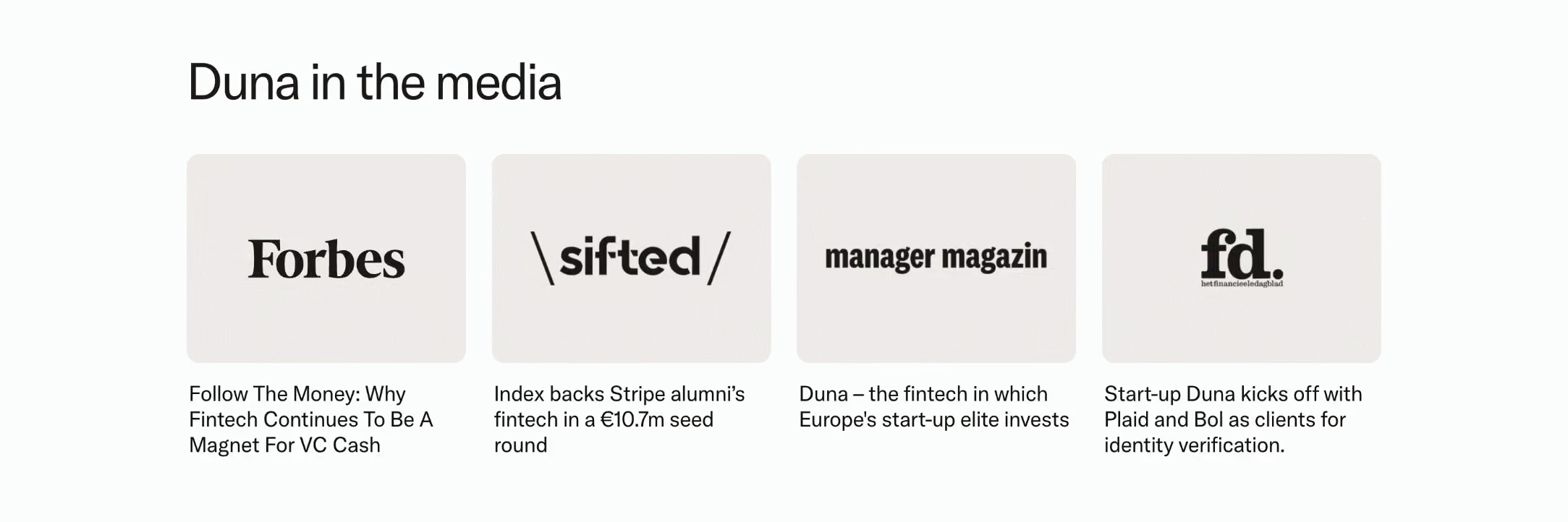
The Duna capture uses four cards beneath a clear media heading. Each card gives the publication mark substantial space, followed by a headline. The headlines describe different company-related stories. This combination lets visitors identify both the source and the subject before opening an article.
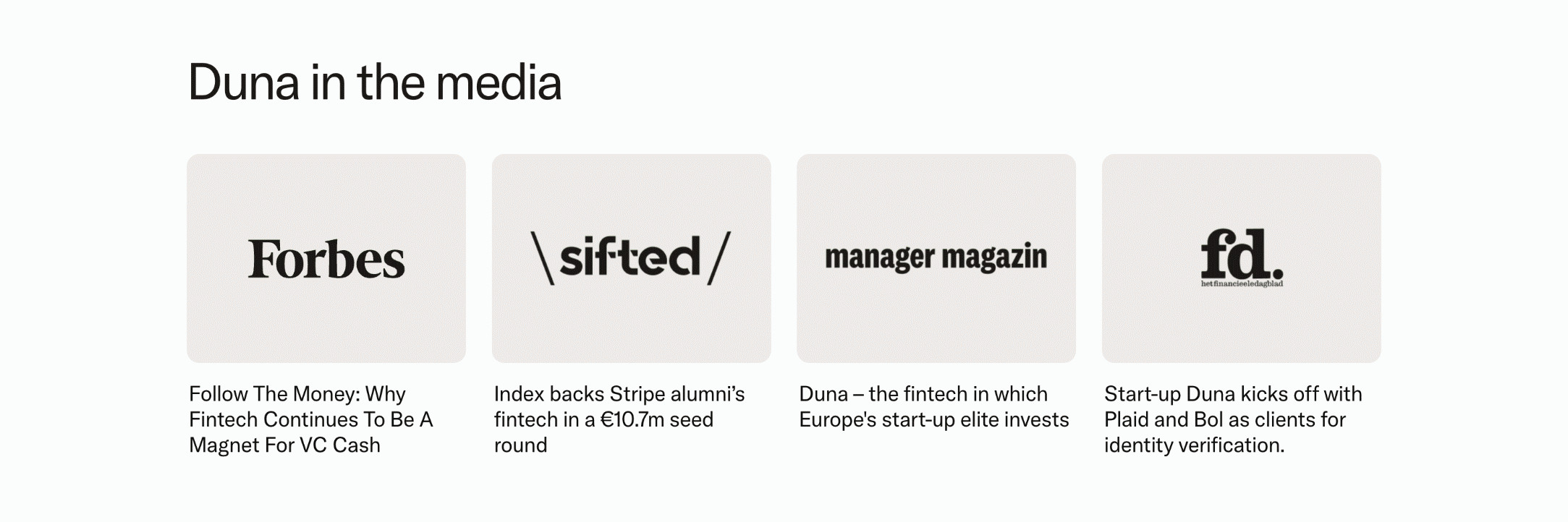
The useful design relationship is source plus topic. The screenshot is evidence of the captured presentation, not independent verification of the historical funding or customer claims contained in its headlines. A guide can study the information hierarchy without repeating those claims as current company facts.
When adapting this layout, preserve enough headline context to distinguish the articles. A card that shows only a publication logo forces visitors to guess what the publication covered. If the headline is long, allow a readable treatment rather than cropping away the part that identifies the subject.
The Superlist capture pairs two publication identities with prominent editorial excerpts. Each source has a visible name and an outward-arrow cue; the text beneath explains a perspective on the product. The section emphasizes the substance of the coverage rather than presenting only a row of media marks.

This approach suits a small set of coverage whose wording is informative. It also requires careful selection: an excerpt should preserve the original meaning and identify its source. Do not turn a qualified assessment into an unqualified endorsement by omitting the surrounding limitation.
For your own page, choose a brief excerpt only when you have a sound basis to use it, and provide a route to the original article. Summarizing the subject in original language may be more appropriate than reproducing a long passage. The displayed quote is evidence to investigate, not a replacement for the article.
Dates can help visitors interpret whether an article concerns a launch, an older product version, or a recent development. They are especially useful when coverage describes a capability that has changed. A press section without dates can accidentally make historical coverage appear current.
Use a clear content type when it matters: review, interview, profile, announcement, or company news. A paid placement or sponsored article should not be presented in a way that obscures that relationship. The label should match the source material rather than borrowing the appearance of independent reporting.
Do not invent a date or classification when the source record is incomplete. Resolve the missing information before publishing a definitive summary. If the article is archived or no longer available, make an appropriate editorial decision instead of silently pointing visitors to unrelated coverage.
The destination should let visitors examine the coverage the card references. A publication homepage can make the source recognizable while leaving the actual evidence impossible to find. Verify the article link and ensure the visible title corresponds to the destination.
Give external destinations clear context. An outward arrow can supplement a label, but it should not be the only explanation of where the link goes. The publication name and article topic should remain understandable when images are unavailable or someone navigates by link text.
If the source has an access requirement, consider whether that condition should be indicated. Do not promise a freely readable full article when visitors will encounter an unexpected subscription wall. Avoid copying restricted content into your own card merely to bypass the source's access model.
Recognizable media marks can lend apparent authority to a page. That makes accurate labeling especially important. A publication may have mentioned a company without reviewing or recommending its product. Wording such as covered by is different from wording that suggests approval.
Place a headline, source link, or concise context near the mark so the relationship is inspectable. A dense logo wall with no destinations can create a stronger impression than its evidence supports. If the goal is a press archive, a structured list may be more useful than a decorative trust strip.
Review asset quality and consistency without altering the meaning of the source identity. A uniform container can make different marks easier to scan, as the Duna capture demonstrates. The surrounding layout should organize the sources rather than suggest a shared certification or partnership.
A homepage usually needs a small selection whose relevance is clear. A press page may need a broader chronological archive with filters or grouping. These contexts have different information needs: a promotional section should support the page argument, while an archive should help people find specific coverage.
Choose ordering deliberately. Recent coverage can come first when timeliness matters; a substantive product review may deserve priority when visitors are evaluating the product. Do not let logo prominence become the only selection criterion if the article itself adds little useful information.
Provide a route to all coverage when the selection is partial. That route can also help journalists or other readers find company context without turning the main page into a long catalogue. Keep press resources, contact information, and third-party coverage clearly labeled if they share a broader media area.
Large excerpts can be visually expressive, but they need comfortable line lengths and readable contrast. A small label above a large quotation should still be legible enough to identify the source. Avoid making attribution visually secondary to the point that it becomes easy to miss.
On mobile, keep each source associated with its own headline or excerpt. A multi-column section can become confusing if all logos stack first and all text follows later. Preserve the card or source grouping in the reading order.
Use live text for essential context where possible. Publication marks can be images, but a headline embedded in an image is harder to resize, translate, and access. Ensure links can be reached by keyboard and that repeated actions have enough context to identify their specific article.
Press links, headlines, and article availability can change. Assign ownership for checking the section and updating its records. A historical article can remain useful, but it should not silently become a current claim about the product or company.
Review excerpts when the surrounding page proposition changes. A quote selected for an older positioning may no longer support the current argument. Retain source context and avoid rewriting a quotation to fit new messaging. If a summary changes, keep it clearly distinguishable from verbatim source language.
Check fallback behavior for missing logos and broken links. The section should remain intelligible without every asset. A source name and article topic can preserve usefulness even when a visual mark fails to load.
Ask readers to describe the relationship between the publication and the company. If they infer endorsement from a general news mention, improve the wording. If they cannot identify which article is referenced, strengthen the context and destination labeling.
Verify source links, dates, excerpt accuracy, and the association between each card and its destination. Assess the section within the whole page so it supports the visitor's decision without displacing more relevant product evidence.
Explore the SaaSFrame press-mentions collection to compare headline-led media cards with excerpt-led sections. Look for the balance of source recognition, context, and traceable destinations that suits your own coverage.
Is a publication logo enough? It can identify a source, but it does not explain what was covered. Pair it with context and a specific destination when the section is intended to provide inspectable evidence.
Should old coverage be removed? Not necessarily. Historical articles can be useful if their date and scope are clear. Review whether they still support the page's current purpose and avoid presenting old observations as current product facts.
Should a press mention be described as an endorsement? Only when that description accurately reflects the source. A news article, interview, or company profile should be labeled according to what it actually is, with a route for visitors to read the coverage themselves.