Maintenance Emails
1


We sell SaaSFrame licenses on Gumroad, a secured online selling platform for creators.
SaaSFrame gets updated all the time! Every new update and version will immediately be made available to all SaaSFrame users.
The licence key required to create your SaaSFrame account is send by Gumroad once you made your purchase. If this email is blocked by your email client, send me an email at antoine[at]unmake[dot]io so I can resend the licence key.
You can generate an invoice on Gumroad once you purchased SaaSFrame. You will find the link in the order confirmation email.
If you're not satisfied, you can ask for a refund within 7 days. Just send me an email at antoine[at]unmake[dot]io
A SaaS maintenance email explains an operational change that may affect users' work. Its design should make the timing, affected scope, expected impact, and any required preparation or recovery clear.
Name the planned work and identify the affected product area. Users should not need to read a promotional introduction before learning that their workflow may change.
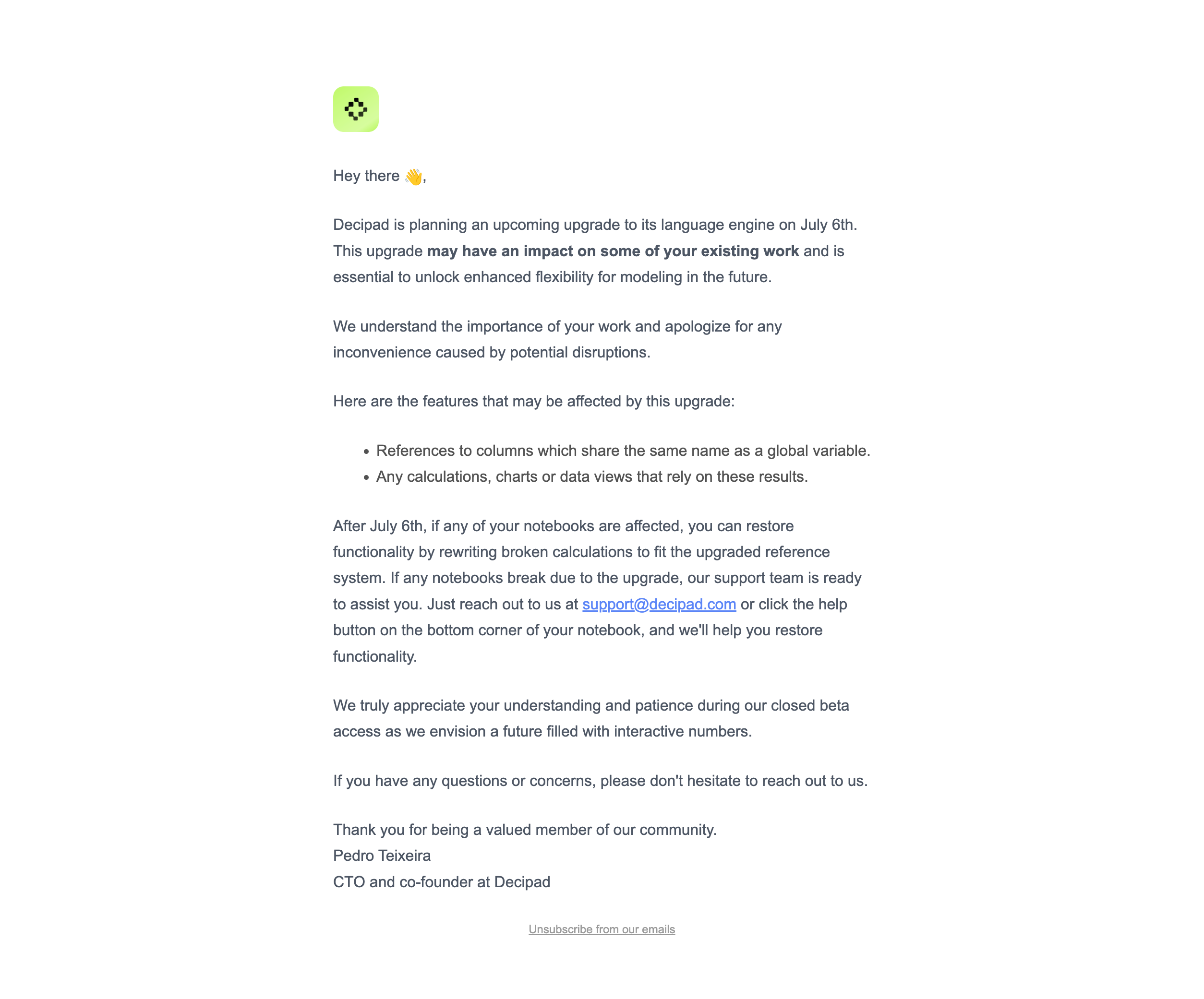
The Decipad reference describes an upcoming language-engine upgrade, lists potentially affected functionality, and explains how users can restore affected notebooks or contact support.
This gives the notice a practical structure: change, impact, recovery. The captured date and technical details belong to that historical update rather than a general maintenance recommendation.
Provide the actual date, relevant time window, and timezone when the event depends on scheduling. Distinguish an estimated window from a firm commitment.
If the change applies after a release rather than during downtime, explain that model. Maintenance and migration are related but not identical events.
Avoid a vague soon statement when users need to prepare work. Conversely, do not invent precise timing the operating team cannot support.
List the actions or data that may be affected and distinguish them from unaffected functionality only where that helps planning.
Do not imply complete unavailability when only a specific operation changes. A broad outage warning can cause unnecessary disruption if the actual scope is narrower.
Use language aligned with the implementation's established impact. A design reference cannot verify another product's operational guarantees.
Preparation happens before the event; recovery or adjustment may happen after it. Give each required action a clear time and purpose.
If no user action is needed, state that accurately. Avoid adding a ritual acknowledgement that does not help the operation.
For a recovery guide, identify the expected result and support route. Request accepted and restored functionality should remain distinct states.
Provide an appropriate status or documentation route when it exists. Users should know where to find changes to timing or impact.
A follow-up completion message should report the actual state. Do not claim restoration merely because the planned window has ended.
If work is delayed, update the expectation rather than leaving the original email as the only available account.
Use clear headings, concise instructions, and descriptive links. Essential information should work without decorative images.
Check smaller screens and long technical labels. Users may read the message quickly while deciding how to continue work.
Avoid unrelated promotional CTAs that compete with preparation or support.
Verify timing, scope, actions, and destination content against the actual plan. Test the recovery route and the wording used if the operation changes.
Use SaaSFrame's maintenance-email reference to study impact and recovery hierarchy. Design around helping users plan and respond to a real change.
No. Explain the actual operational effect, which may involve migration or changed behavior rather than complete unavailability.
Identify timing, affected scope, and consequential action before secondary context.
Only when the responsible system or team establishes the completed state, not merely when the planned window expires.