Prompt 1,069 words Copy
# Design from Reference: Mintlify Add Custom Domain

Create an original, high-fidelity visual design inspired by the reference. Prioritize composition, typography, colors, spacing, and component styling over technical implementation.

## Reference

- **Product:** Mintlify
- **Category:** Settings
- **Screenshot:** attached to this message (also available at https://media.saasframe.io/v/c624a0f8c388a07e7fcb-1600.webp)
- **Source:** https://dashboard.mintlify.com/settings

Analyze the attached screenshot first. If no image is attached, open the screenshot link; if neither is accessible, ask for it rather than guessing.

## Visual Design Context

### Overall aesthetic

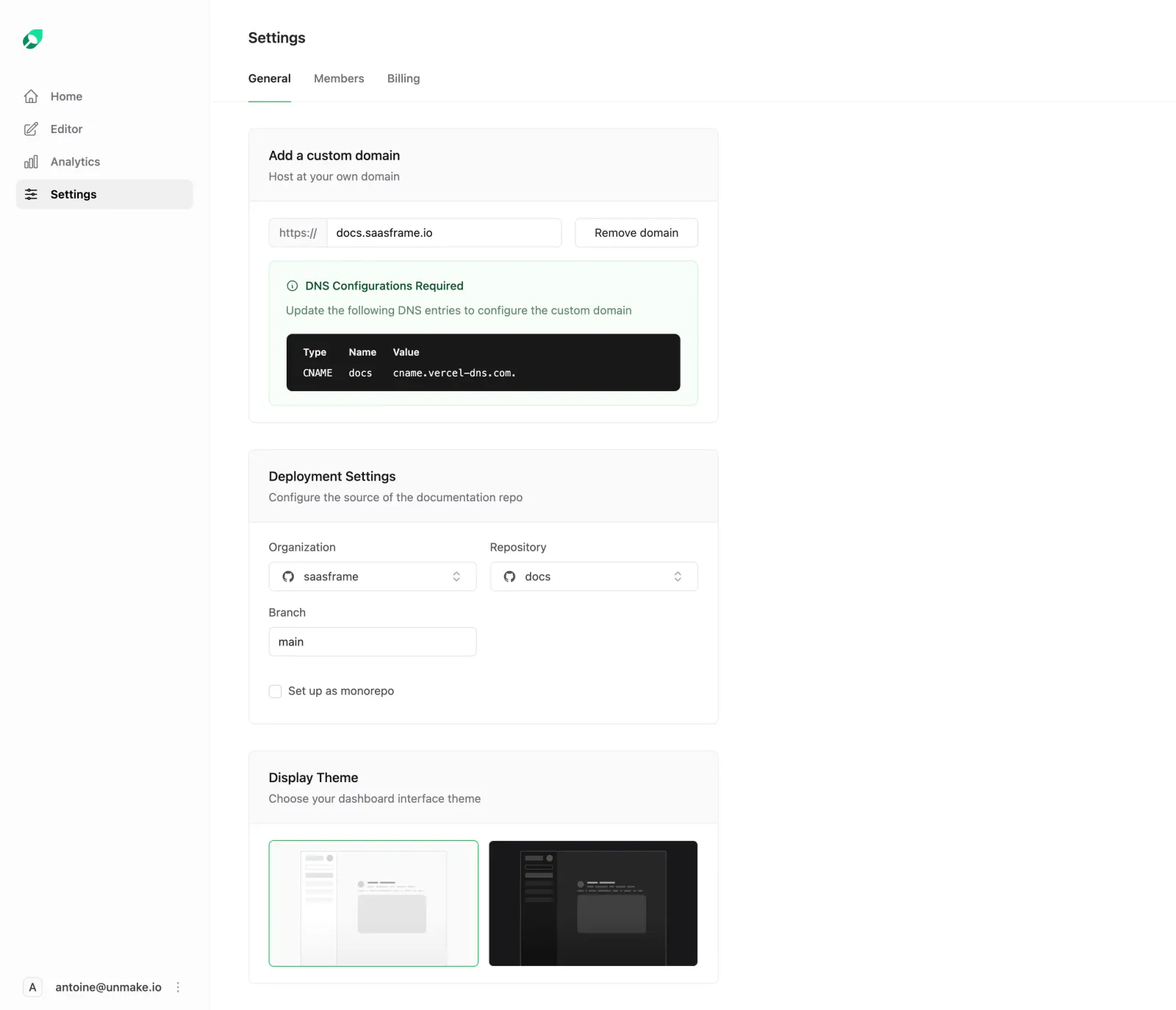
- **Character:** A quiet documentation settings screen with white cards, pale headers and a restrained green accent. Technical configuration is presented in clear labeled groups.
- **Image basis:** The 2880 × 2474 source was inspected at approximately 1400 × 1203. Dimensions below are inspection-pixel estimates; CSS scale and device pixel ratio are unverified.

### Page composition

- **Sidebar:** A roughly 249 px pale rail contains a small green logo, four icon/text navigation items and a bottom account row.
- **Page header:** The main area begins around x295 with a Settings heading and three tabs. General is active with a thin green underline.
- **Configuration column:** Three approximately 560 px wide cards stack vertically: custom domain, deployment and display theme. Large unused white space remains to the right.
- **Card structure:** Each card has a pale title/description header separated by a fine rule from its controls.

### Information hierarchy

- **Domain:** A domain field and removal action precede a green-tinted configuration-required message containing a dark DNS table.
- **Deployment:** Two side-by-side selectors establish organization/repository; a branch field and unchecked monorepo option follow.
- **Theme:** Two large preview tiles show light and dark variants; the light tile has a green selected border.
- **Observed state:** Settings navigation and General tab are selected. The domain requires DNS configuration. No dropdown, error dialog or save confirmation is open.

### Typography

- **Page title:** Approximately 18 px semibold sans-serif.
- **Card titles:** Around 16 px medium, with 14 px muted descriptions beneath.
- **Fields:** External labels and input values use approximately 14 px; navigation is around 14 px medium.
- **Technical text:** The DNS values use compact roughly 12 px monospaced text on dark. Exact font families and CSS metrics are unverified.

### Colors & surfaces

- **Measured base:** White #FFFFFF, pale #FCFCFC and #FAFAFA define canvas and card headers.
- **Measured message:** Very pale green #F7FEFA fills the DNS guidance panel.
- **Measured darks:** #181919, #18181B and #262626 appear in the code/table and dark-theme preview.
- **Accent:** Green marks the brand, active tab, selected theme and informational message border. Pale gray outlines structure other controls.

### Components

- **Sidebar rows:** Icon/text items use a rounded pale-gray selected Settings background; inactive labels remain muted.
- **Domain control:** A segmented protocol prefix and value field align beside an outlined Remove domain button. Controls are about 35 px high.
- **DNS panel:** A green outlined inset contains an information icon, title, helper text and a dark rounded table with three headings and one data row.
- **Deployment controls:** Two roughly 248 px wide selectors include leading provider icons and right chevrons. A similarly sized branch input appears below.
- **Checkbox:** A small empty outlined square precedes the monorepo label.
- **Theme previews:** Two approximately 249 × 150 px bordered miniatures show abstract light/dark interface layouts; the left border is green.
- **Card geometry:** Roughly 8 px corners, 24 px inner padding and thin pale borders. No hover/focus state is visible.

### Visual rhythm

- **Shared width:** All cards align to one narrow main column, preserving large right-side whitespace.
- **Stacking:** Approximately 31 px gaps separate cards; repeated title/description headers create predictable grouping.
- **Form rhythm:** Labels sit close above controls, with larger gaps between separate configuration concepts.
- **Contrast:** The dark DNS block is the main local contrast event within an otherwise bright page.

### Responsive

- **Evidence limit:** Only desktop settings are observed.
- **Recommended form:** Make cards fluid, stack paired selectors and allow the domain/remove row to wrap.
- **Recommended technical content:** Preserve DNS column relationships with safe wrapping or horizontal scrolling.
- **Recommended navigation:** Collapse the sidebar and retain clear active-tab identification.
- **Recommended theme:** Keep preview choices large enough for touch and provide text labels for their selection.

### Adaptation guidance

- **Preserve:** Keep explicit grouping, external labels, readable technical values and restrained green state indicators.
- **Build:** Reuse settings-card, labeled-field, configuration-message and theme-option components.
- **State design:** Distinguish configuration required, verified domain and error states with text as well as color.
- **Validate:** Confirm font metrics, keyboard selection, field focus and responsive DNS readability. Screenshot configuration values should not be reused as live setup instructions.

## Content

**Instructions:**

Generate realistic example content that fits the selected design reference.

Create appropriate headlines, descriptions, labels, buttons, and supporting copy based on the type of interface being designed.

If a product or business description is provided, use it to guide the content.

Otherwise, invent a plausible fictional SaaS product appropriate for the reference.

Keep the content concise, coherent, and visually balanced.

Do not present fictional statistics, customer names, or testimonials as verified facts.

## Design Direction

**Instructions:**

Use the reference screenshot as the main source of visual inspiration rather than a strict layout template.

Preserve its most distinctive design characteristics, such as typography, visual rhythm, color relationships, component treatments, and overall aesthetic.

Feel free to modify section arrangements, proportions, spacing, and individual components to better suit my content.

Introduce original design decisions where they improve usability, composition, or brand consistency.

The result should clearly reflect the reference's visual language without looking like a direct reproduction.

Follow the visual identity of the reference design.

Use its typography, color palette, component styling, and overall aesthetic as the primary design direction.

Do not introduce an unrelated visual identity.

## Output

**Instructions:**

Generate a high-fidelity visual mockup of the requested interface.

Present the design as a polished, realistic website or product UI screenshot.

Prioritize visual composition, typography, spacing, colors, alignment, and component details.

Use the available image-generation or visual-design capabilities.

Do not replace the mockup with source code, a written design specification, or a textual description.

If direct visual generation is unavailable, clearly explain the limitation.

## Constraints

- Use the actual screenshot as the primary visual reference.
- Preserve essential messaging and factual accuracy.
- Prioritize visual quality and consistency.
- Do not invent unsupported product claims.
- Adapt structure and copy length for visual balance.
Reference image Attach it to your message: assistants can’t open image links. Open in ChatGPT ↗ Open in Claude ↗
Build it in Lovable ↗ v0 ↗ Figma Make ↗
Opening a tool copies the screenshot so you can paste it with your prompt.
 SaaSFrame