
Thank you! Your submission has been received!
Oops! Something went wrong while submitting the form.
Get SaaSFrame Pro
Monthly
$18
Quarterly
$48
Yearly
$180
Upgrade to access this feature
Browse all screens & flows
Filter and search screens & flows
Access Figma files
Access mobile versions
Bookmark screens & flows
Join now
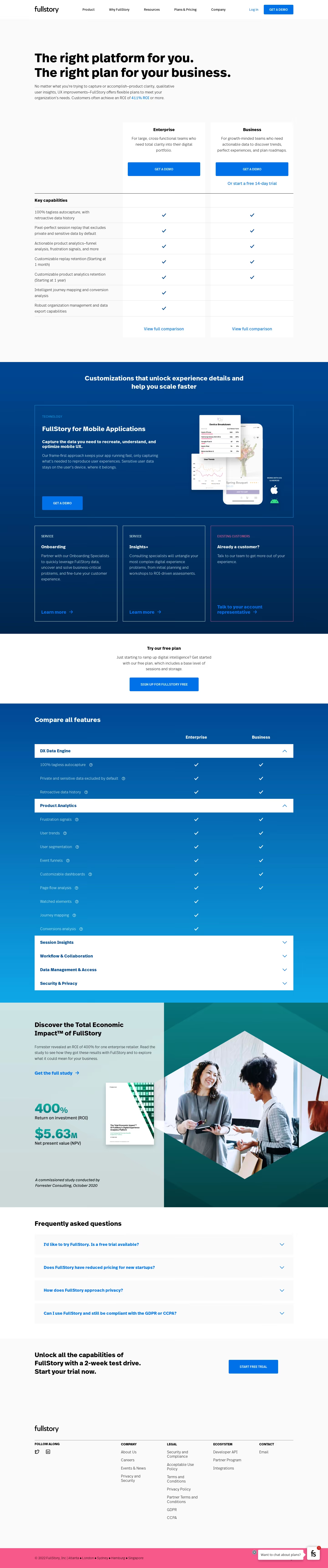

Fullstory Pricing Page

Fullstory
Digital experience analytics
Designed by
No items found.

Bookmark
Bookmark

Design with AI
Thank you! Your submission has been received!
Oops! Something went wrong while submitting the form.
# Design from Reference: Fullstory Pricing Page
Create an original, high-fidelity visual design inspired by the reference. Prioritize composition, typography, colors, spacing, and component styling over technical implementation.
## Reference
- **Product:** Fullstory
- **Category:** Pricing Page
- **Screenshot:** https://cdn.prod.website-files.com/5e9dc792e1210c5325f7ebbc/62eca43ea4f21f542ea2b853_1659674886280-62ec9c9edf1bb87e0af89fab_screenshot-device-333ff77695c1e2840053d15fdc3441ff-1659617455406.webp
Analyze the screenshot first. If inaccessible, request it rather than guessing.
## Content
{{content.instructions}}
{{content.data}}
Preserve essential messaging and factual accuracy. Adapt structure and copy length for visual balance; never invent product claims.
## Visual Design
### Overall aesthetic
- **Style:** A substantial enterprise pricing page with bold black typography, blue actions, comparison tables, and broad blue-gradient feature regions.
- **Character:** Practical and evidence-led, alternating dense comparison content with service cards, a research promotion, FAQ, and conversion sections.
### Page composition
- **Capture and scale:** The image measures 1440 × 6878 pixels. Following dimensions are approximate screenshot pixels; CSS scale is unverified.
- **Opening:** A white navigation header precedes a left-aligned two-line heading and compact explanatory paragraph on near-white. A three-column comparison aligns feature labels left and Enterprise/Business plans in two white columns.
- **Services:** A dark-blue gradient region contains a centered heading, one wide mobile-product panel with copy and device/data artwork, and three service/customer panels below.
- **Full comparison:** A centered white free-plan section separates the first gradient region from a second blue-to-cyan comparison area. Category bars divide expandable feature groups; two groups are expanded in the screenshot.
- **Closing regions:** A split research promotion pairs teal metrics/report artwork with a large angular-cropped photograph. Four FAQ rows, a trial banner, a multicolumn footer, a pink copyright strip, and a small chat prompt finish the page.
### Information hierarchy
- **Plan decision:** The opening comparison foregrounds plan names, descriptions, demo actions, and checkmark-based inclusions rather than public numeric prices.
- **Detail levels:** A compact key-capabilities table introduces the plans; the later grouped comparison supplies more detailed feature coverage.
- **Conversion and proof:** Demo, free-plan, research, and trial actions form distinct secondary paths, supported by service explanations and the study illustration.
### Typography
- **Family:** A neutral sans serif with heavy headings and lighter body text is visible; exact font identity is unverified.
- **Display:** The opening headline is approximately 52–56 px, weight 750–800, with 1.15 line-height.
- **Section headings:** Major subsection headings are around 28 px bold; plan/service titles approximately 18–20 px bold.
- **Body and labels:** Body copy and table descriptions are roughly 16–17 px with 25–27 px line-height. Buttons use compact 13–14 px uppercase labels. Table category bars use about 18 px bold text.
- **Evidence figures:** Research metrics use large bold teal figures with smaller explanatory labels beneath.
### Colors & surfaces
- **Foundation:** Sampled sRGB #FAFAFA and #FFFFFF form the light page and comparison panels.
- **Blue system:** Sampled action blue #0171EA contrasts with dark blue #004085 and #00336A in gradient regions. The lower comparison transitions toward cyan; exact gradient endpoints are unverified.
- **Research:** Sampled pale blue-gray #CDD8D9 and #CDDFE0 support the research artwork, with deeper teal photography framing.
- **Closing accent:** Sampled pink #F7598A defines the lower copyright band and appears as a small customer-service accent.
- **Text contrast:** Use near-black on light regions, white headings on blue, and softer light-blue body copy within dark panels.
### Components
- **Plan comparison:** A roughly 1135 px-wide frame uses three near-equal columns. Thin horizontal lines divide capability rows, with blue checks centered under the two plans. White plan panels have square corners and full-width blue actions.
- **Service panels:** Fine outlined rectangular cards use generous padding and bottom-positioned links. The wide mobile panel pairs text left with layered smartphone/analytics imagery right.
- **Detailed comparison:** White full-width category bars carry dark-blue labels and right chevrons. Expanded rows show feature text and small information icons left, with checkmarks in fixed plan columns.
- **Research feature:** A full-width split composition combines text, two large numeric highlights, a report cover, and a large photograph inside a teal geometric frame.
- **FAQ and CTA:** Four pale rectangular FAQ rows use blue bold questions and right chevrons. A separate pale trial banner pairs a multiline heading left with a blue action right.
- **Footer:** Compact link columns sit below a brand lockup and thin rule. The chat prompt overlaps the lower-right edge.
### Visual rhythm
- **Vertical rhythm:** Use approximately 90–130 px between broad regions, while table rows maintain a steady 60–70 px pitch.
- **Grid alignment:** Keep comparison checks aligned under persistent plan headings. Match service-card heights and bottom-link positions.
- **Contrast pacing:** Alternate white/near-white reading areas with blue comparison fields and the teal research image region; avoid additional decorative surface changes.
### Responsive
- **Observed state:** Only desktop is provided. Expanded and collapsed comparison groups coexist in the captured state.
- **Recommended reflow:** Stack service cards and the research split; let comparison tables scroll horizontally or offer a plan-by-plan mode with visible row labels.
- **Small-screen controls:** Wrap long FAQ questions, preserve chevron space, and stack the trial banner. Keep chat from covering key actions.
### Adaptation guidance
- **Preserve:** Retain the two-level plan comparison, strong blue actions, grouped feature details, service-grid support, research proof, and FAQ-to-trial close.
- **Adapt:** Use verified plan inclusions, service descriptions, research evidence, and trial terms for the new product. Remove unsupported metrics and claims.
- **Avoid:** Do not invent public prices or hidden accordion content. Keep detailed comparison structure proportional to the actual number of features.
Use this context to reproduce the reference's visual language: layout, typography, colors, spacing, borders, radii, and distinctive elements. The screenshot takes priority if descriptions conflict.
## Direction
{{preferences.fidelityInstructions}}
## Output
{{output.instructions}}
Deliver a polished, cohesive design with precise alignment, hierarchy, and spacing. Produce the requested visual artifact, not just a description. If unsupported, explain the limitation.


Category
Patterns
No items found.
Tech Stack

Added on
April 29, 2020
Similar screens




Upgrade to SaaSFrame Pro now to see similar examples.
Monthly
$18 /month
Billed $18 monthly
Browse all screens & flows
Filter and search screens & flows
Search text in screenshots
Access Figma files
Access mobile versions
Join now
Quarterly
$16 /month
Billed $48 quarterly
Browse all screens & flows
Filter and search screens & flows
Search text in screenshots
Access Figma files
Access mobile versions
Join now
Yearly
$15 /month
Billed $180 yearly
Browse all screens & flows
Filter and search screens & flows
Search text in screenshots
Access Figma files
Access mobile versions
Join now