Prompt 597 words Copy
# Design from Reference: Pivot Ebook Page

Create an original, high-fidelity visual design inspired by the reference. Prioritize composition, typography, colors, spacing, and component styling over technical implementation.

## Reference

- **Product:** Pivot
- **Category:** Ebook Page
- **Screenshot:** attached to this message (also available at https://media.saasframe.io/v/d3e936176b151147e183-1600.webp)
- **Source:** https://www.pivotapp.ai/guides/your-guide-to-finance-first-procurement

Analyze the attached screenshot first. If no image is attached, open the screenshot link; if neither is accessible, ask for it rather than guessing.

## Visual Design Context

### Overall aesthetic

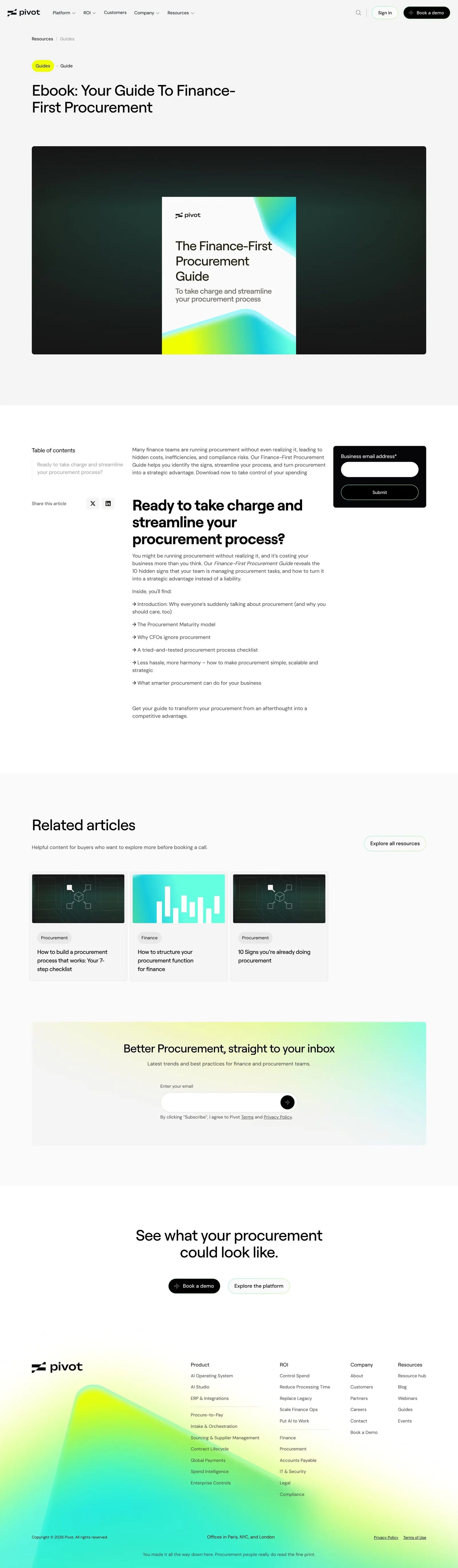
- **Character:** Pivot's editorial template: gray header, dark cover with a white book mockup, white body and a black sticky form card.

### Page composition

- **Capture:** 2880 × 9866 screenshot pixels; 2× CSS scale (1440px viewport).
- **Structure:** Breadcrumb; header with chips and title; wide dark cover with book mockup; three-column body (TOC and share left, description centre, sticky email form right); related articles; newsletter block; closing CTA; gradient footer.

### Information hierarchy

- **Priority:** Title and cover, value promise, chapter list, then the one-field form.

### Typography

- **Families:** Roobert for headings, DM Sans for body.
- **CSS scale:** Title 32px, H2 28px bold, body 13px, form label 10px.

### Colors & surfaces

- **Palette:** Header #F4F4F4, body #FFFFFF, form card #060609 with white input, text #060609 and #464646.
- **Accents:** Lime Guides chip, gradient on the book cover.

### Components

- **Elements:** Chips, book mockup on dark panel, arrow list of chapters, sticky form card with single input and outlined button, related article cards.
- **Geometry:** Article column about 400px, form card 200px, radius 8px.

### Responsive

- **Mobile capture:** The form card moves inline below the intro.

### Adaptation guidance

- **Transfer:** Present a gated asset like an article with a clear chapter list and a one-field gate beside it. Use a mockup of your real asset.

## Content

**Instructions:**

Generate realistic example content that fits the selected design reference.

Create appropriate headlines, descriptions, labels, buttons, and supporting copy based on the type of interface being designed.

If a product or business description is provided, use it to guide the content.

Otherwise, invent a plausible fictional SaaS product appropriate for the reference.

Keep the content concise, coherent, and visually balanced.

Do not present fictional statistics, customer names, or testimonials as verified facts.

## Design Direction

**Instructions:**

Use the reference screenshot as the main source of visual inspiration rather than a strict layout template.

Preserve its most distinctive design characteristics, such as typography, visual rhythm, color relationships, component treatments, and overall aesthetic.

Feel free to modify section arrangements, proportions, spacing, and individual components to better suit my content.

Introduce original design decisions where they improve usability, composition, or brand consistency.

The result should clearly reflect the reference's visual language without looking like a direct reproduction.

Follow the visual identity of the reference design.

Use its typography, color palette, component styling, and overall aesthetic as the primary design direction.

Do not introduce an unrelated visual identity.

## Output

**Instructions:**

Generate a high-fidelity visual mockup of the requested interface.

Present the design as a polished, realistic website or product UI screenshot.

Prioritize visual composition, typography, spacing, colors, alignment, and component details.

Use the available image-generation or visual-design capabilities.

Do not replace the mockup with source code, a written design specification, or a textual description.

If direct visual generation is unavailable, clearly explain the limitation.

## Constraints

- Use the actual screenshot as the primary visual reference.
- Preserve essential messaging and factual accuracy.
- Prioritize visual quality and consistency.
- Do not invent unsupported product claims.
- Adapt structure and copy length for visual balance.
Reference image Attach it to your message: assistants can’t open image links. Open in ChatGPT ↗ Open in Claude ↗
Build it in Lovable ↗ v0 ↗ Figma Make ↗
Opening a tool copies the screenshot so you can paste it with your prompt.
 SaaSFrame